
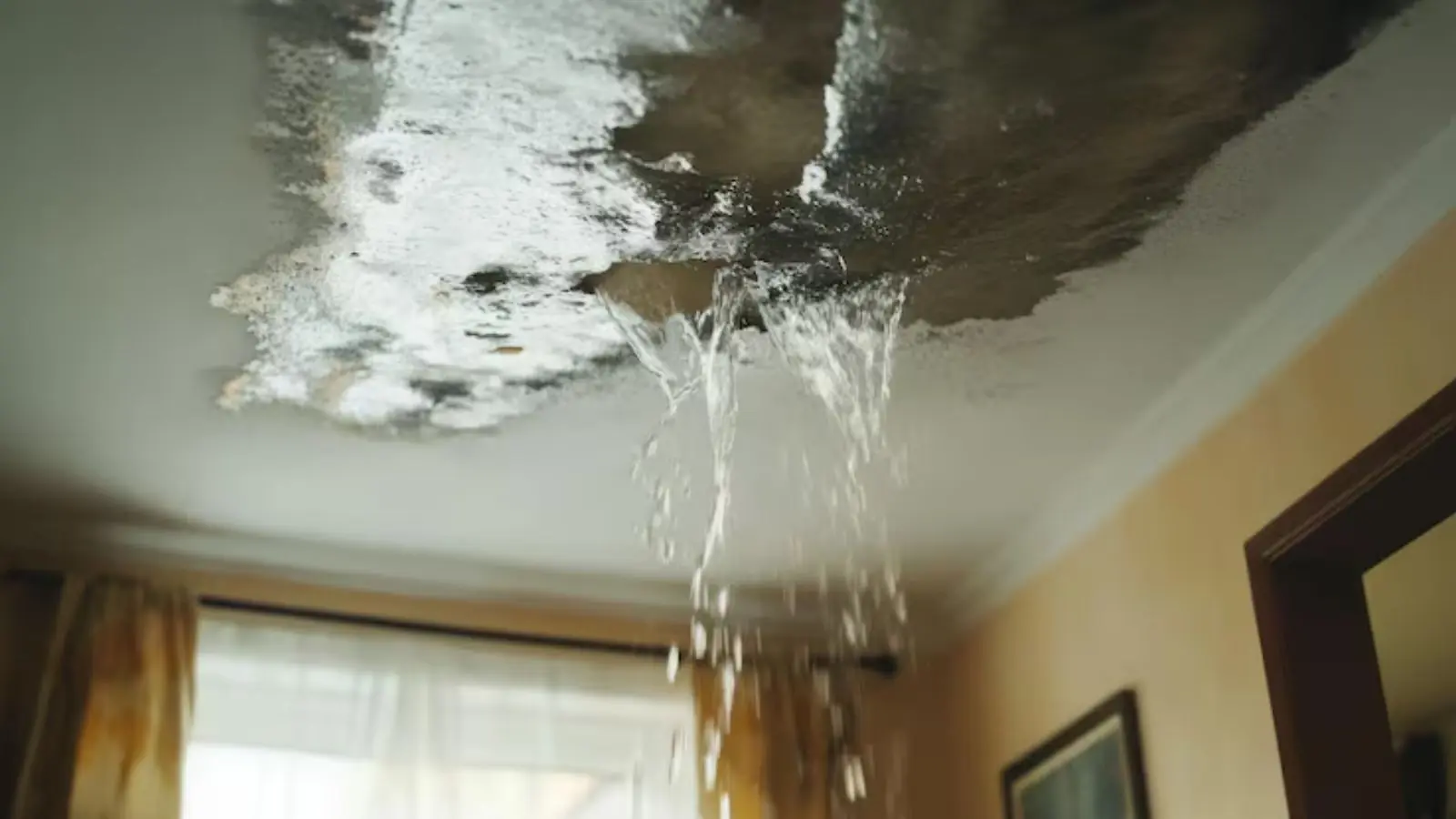
When an air conditioner leaks, shut off the system at the thermostat, stop the drip and dry the area before you repair anything. In Tarzana, where cooling runs for months, a clogged condensate line is among the likelier causes of a stained ceiling, a soaked closet floor or a damp attic. This guide walks through what to do first and how the repair fits together.
Why air conditioners leak
Cooling air removes moisture, and that moisture drains away through a condensate line. When the line clogs, the water backs up and overflows the drain pan, then soaks insulation, drywall and framing below. The common causes are slime and debris in the line, a cracked or disconnected line and a drain pan that has rusted through.
Frozen coils are a second route. Restricted airflow can let the coil ice over, and when the ice melts it can overwhelm the pan. A dirty filter is a frequent trigger and the cheapest thing to check first.
What to do in the first hour
Do the following in order, and stop at any step that is not safe.
- Turn the system off at the thermostat, then at the breaker if the panel is dry and reachable.
- Place a bucket under active drips, and move belongings out from under the stain.
- Check the filter and the drain line opening if you can reach them safely.
- Photograph the damage, including the unit, the pan and the ceiling.
- Call a restoration crew if insulation, drywall or flooring is wet, and an HVAC technician to fix the cause.
Two trades, one job
An HVAC technician fixes the cause, by clearing the line, replacing the pan or repairing the unit. A restoration crew dries and repairs the damage. Doing only one leaves the other problem in place, and a repaired drain that still feeds a wet ceiling invites mold.
For the drying side, see water mitigation. For ceilings, walls and floors that must be rebuilt afterward, water damage repair covers the options.
Why this matters in Tarzana and Woodland Hills
Tarzana has a hot-summer Mediterranean climate with wide day-to-night swings, and the neighborhood next door, Woodland Hills, recorded 121 degrees Fahrenheit at Pierce College on September 6, 2020, the highest reading on record for Los Angeles County according to published accounts. Systems that run through that heat produce a lot of condensate.
The practical habit is to service the drain line before summer and check ceilings under air handlers after the first hot week. If the air handler is in an attic, a leak can run unseen above a ceiling until a stain appears below. Hot attics also dry out quickly, which can hide a leak that has already soaked the insulation.
What gets repaired after an air conditioner leak
Repairs depend on what the water reached and for how long.
| What got wet | Usual outcome | Next step |
|---|---|---|
| Attic insulation | Often replaced if soaked | Dry the framing, then replace insulation |
| Ceiling drywall | Cut out if soft or sagging | Dry, replace, texture and paint |
| Closet carpet or flooring | Pad replaced, floor dried | Dry the subfloor, then re-lay |
| Wall cavity below | Opened if readings are high | Dry, check for mold, close |
Insurance and a condensate leak
Policies often treat a sudden overflow differently from a slow drip that ran for months. Check your policy, photograph the damage before repairs and keep the HVAC technician's invoice, which can show the cause. The California Department of Insurance advises keeping receipts for temporary repairs.
Homes in Woodland Hills and Reseda can call the same dispatch line for a meter check after an air conditioner leak.
Why Tarzana air conditioners leak so often
The San Fernando Valley runs air conditioning for a long stretch of the year, and a system that runs hard makes a lot of condensate. Every pound of moisture pulled from the air has to leave through a drain line, and that line is a small pipe that clogs with algae and dust.
Once the primary drain backs up, water spills into a secondary pan or, if there is none, onto the ceiling or the attic floor. Many homes in this area have air handlers in the attic, so a slow overflow can soak insulation and drywall for days before a stain appears.
Where the water usually shows up first
Look for a brown ring on the ceiling below the air handler, a damp closet wall or a soft spot in the hallway ceiling. Wet insulation also sags and loses its value, which is why a stain often grows after the unit is switched off.
- A ceiling stain that grows on hot days and shrinks on cool days points to condensate.
- Water in the secondary pan means the primary line is blocked.
- A musty smell near a vent or closet suggests the moisture has been present for a while.
- Ice on the coil or lines suggests an airflow problem that later becomes a drip.
What to do before anyone arrives
Switch the system off at the thermostat so it stops making more water. Place a bucket under any drip, move belongings and photograph the stain before you touch it. If the ceiling bulges, poke a small hole to release the water into a bucket rather than waiting for a collapse.
After the leak is stopped, the wet insulation and drywall need drying and sometimes removal. That work falls under water mitigation, and the later rebuild is covered under water damage repair. A technician should service the drain line itself, because drying a ceiling does not stop the next overflow.
Preventing the next one
Change filters on schedule, have the drain line flushed each spring and consider a float switch that shuts the system off when the pan fills. Keep an eye on ceilings below any attic unit. A float switch costs little compared with a ceiling.
Frequently asked questions
It can be. Active dripping into a ceiling or wall should be stopped and dried quickly. Shut the system off and call if water is spreading.
A short delay with the system off and the drip contained is usually reasonable, but soaked insulation and drywall are best dried within a day or two. Describe it to dispatch and ask.
The HVAC technician fixes the cause. The restoration crew dries and repairs. You usually need both.
Not on its own. A stain on dry, solid drywall can be sealed with a stain-blocking primer and repainted, and a sagging ceiling needs replacement.
It is better to switch it off until the drain is cleared. Running the system keeps producing water that has nowhere to go.